

A “Pixar approach” brings to life the powerful story for kids and adults, helping spread the word about Wisconsin’s miraculous site.
Kids around the world love Catholic podcast The Merry Beggars, which has soared up the rating charts thanks to its captivating audio adventures and exceptional production quality.
Now their talented team has brought to life the incredible true story of Adele Brise, the seer of Our Lady of Champion — the only approved Marian apparition site in the United States.
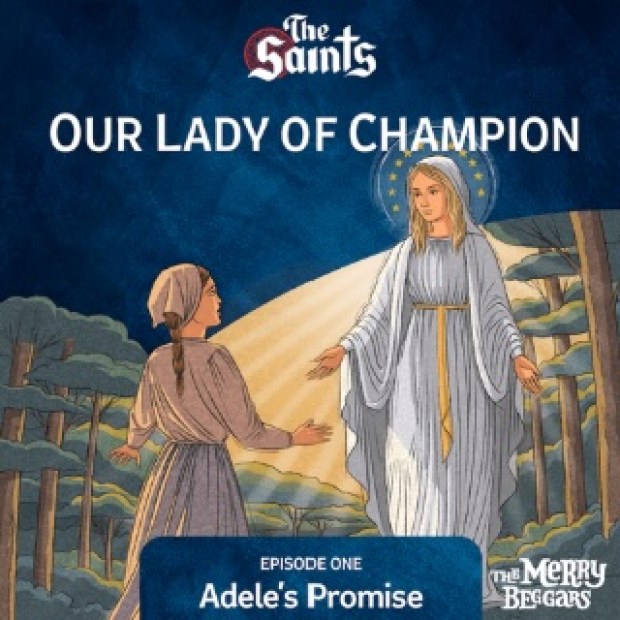
The 5-episode audio series will explore Adele’s early life, her journey to the United States with her family, and the extraordinary encounter with the Queen of Heaven in 1859 that changed her life forever.
The series will also highlight Adele’s unwavering faith and leadership during the Peshtigo Fire of 1871, the deadliest fire in U.S. history.
The National Shrine of Our Lady of Champion collaborated with The Merry Beggars, the entertainment division of Relevant Radio, to produce the one-of-a-kind series.
You can find the first episode of the series here.
Adults and kids love the series
Peter Atkinson, founder and executive producer of The Merry Beggars, shared with Aleteia some of the powerful messages behind the captivating story.
What was the process like to bring to life Adele Brise’s story for the younger generation?
When we adapt saints’ stories for The Saints: Adventures of Faith and Courage we take what we call the “Pixar approach.” That is, we write the story so that it has themes that touch the heart of adult listeners because of their depth and transcendence, while also being exciting and appropriate for younger listeners.
When you’re adapting stories that can have potentially frightening elements, we try to portray them so that older audiences can understand what is happening, without bringing too many intense elements into the actual audio.
What ages would be best to enjoy this audio series?
How can this audio series help people connect not only with her story but also with saints in general, especially for Americans who may not be familiar with our country’s only approved Marian apparition?
The saints are our faith in action. They are our brothers and sisters who model for us what it means to give our lives wholly to God.
A life of faith is the opposite of boring. It is engaging with our world and culture in the deepest way possible — getting right to the heart of reality.
When we hear the stories of St. Maximillian Kolbe or St. Joan of Arc or St. Patrick, we realize that they were sinners and weak and vulnerable, just like us. They can inspire us to recognize that what is most important in life is not what we are capable of, but who we belong to — God the Father who loves us. And that realization frees us to abandon ourselves to our vocation fully.
The saints are real men and women. They had mothers and fathers and brothers and sisters. They fought with their friends. They had favorite foods, books, stories, and music. They played video games and soccer, and wore sneakers and hoodies and tunics and robes. Those stories help us to realize and imagine how we are called to be saints in our lives today, right now.
God is inviting us to a great adventure in our daily life. The question is, can we have the eyes to see it? Knowing the saints’ stories helps us see it, and invites us into it.
What is the most important thing you would want people to know about The Merry Beggars’ audio series on Adele Brise?
That it’s all true. That Mary really did appear to Adele Brise. That God is active in history today.
We are not abandoned to a secular age which is distant from spiritual reality. The stories of our faith are true, historically attested to, trustworthy, and good. They are signs that God is active in our culture and history. We are never alone.
And if that’s true, what does it mean for your life? What might God be inviting you into today? How might you ask for Our Lady’s protection and assistance today?
The Creator of the universe — the stars and the sky — wants to be invited into the intimate crosses that you bear daily. What could be better than that?
This article was originally written by Theresa Civantos Barber and published on Aleteia.